
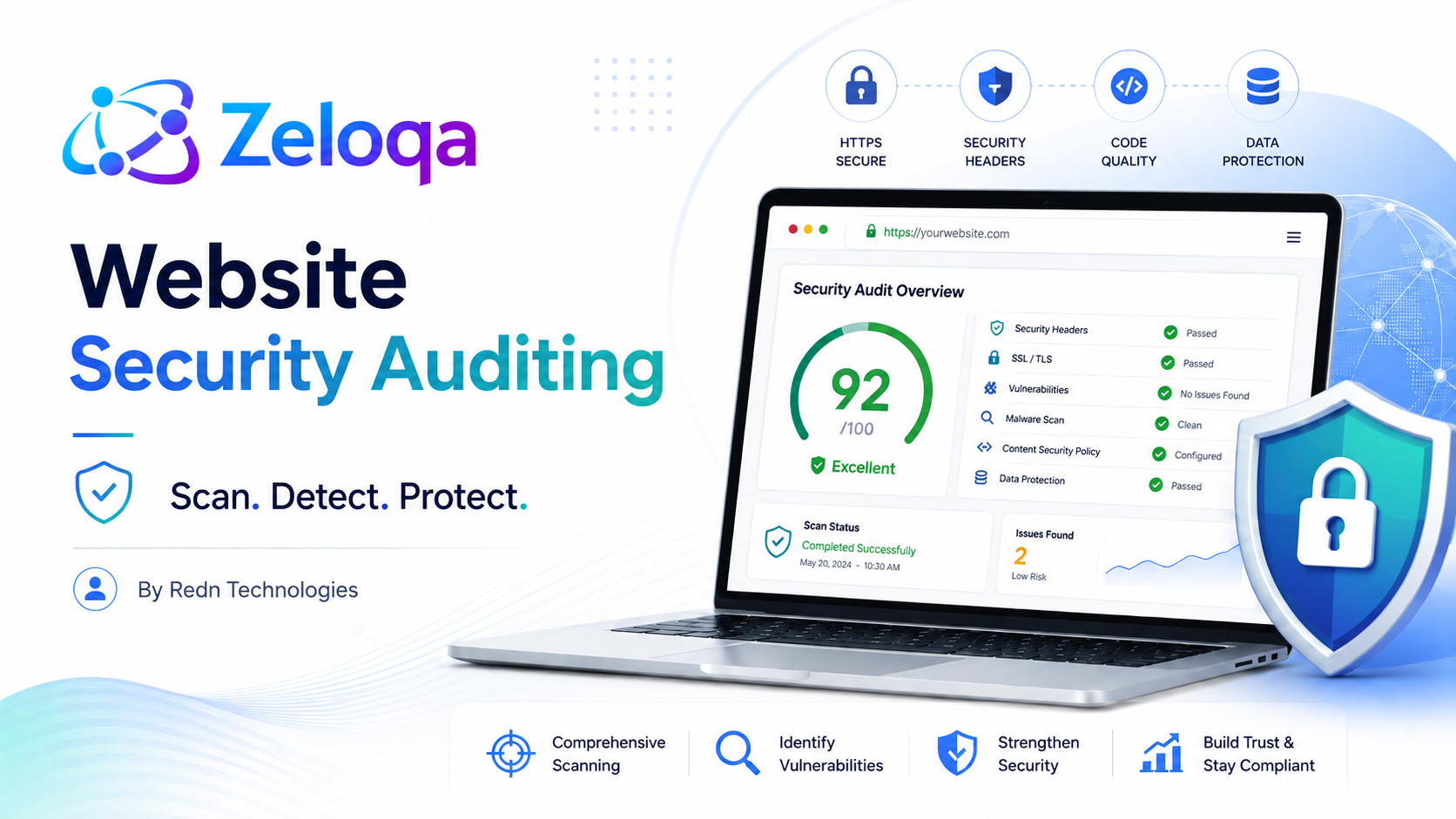
Zeloqa: Smarter Website Security Auditing and Continuous Vulnerability Monitoring
Modern businesses depend heavily on websites, web applications, APIs, and cloud-based platforms. These digital systems process customer information, login credentials, business data, financial transactions, and other sensitive information.
However, even a small website security misconfiguration can expose an organisation to data leakage, unauthorised access, malicious attacks, service interruptions, and reputational damage.
This is where Zeloqa can help.
Developed by Redn Technologies Pvt. Ltd., Zeloqa is an automated website security auditing and vulnerability monitoring platform. It helps website owners, developers, agencies, startups, and enterprises understand their website’s security posture and identify issues that require immediate attention.
What Is Zeloqa?
Zeloqa is a website and API security analysis platform designed to detect common vulnerabilities, configuration problems, exposed sensitive files, outdated dependencies, and other potential security risks.
Instead of requiring users to manually review every website configuration, Zeloqa automates multiple security checks and presents the results through an understandable security grade and detailed audit report.
Users can begin by entering their website domain. The platform analyses the target website and provides information about important security areas, including:
- SSL and TLS certificate configuration
- HTTP security headers
- DNS and domain security posture
- Publicly exposed sensitive files
- Website and application vulnerabilities
- API and endpoint exposure
- Outdated or vulnerable software dependencies
- OWASP and PCI DSS-related security controls
Why Website Security Monitoring Is Important
Website security is not a one-time activity. A website that is secure today may become vulnerable later because of software updates, deployment changes, configuration mistakes, or newly discovered vulnerabilities.
Common reasons for new website security risks include:
- A newly discovered software vulnerability
- An outdated plugin, package, or framework
- An incorrectly configured web server
- A newly launched API endpoint
- An expired SSL certificate
- An exposed backup or configuration file
- A development or deployment mistake
- Changes made by third-party service providers
Continuous security monitoring helps businesses detect these problems before they remain unnoticed for an extended period or are exploited by attackers.
Key Features of Zeloqa
1. Automated Website Security Auditing
Zeloqa automatically examines a website across multiple security categories. It reduces the time required to conduct preliminary security reviews and provides a structured overview of the website’s current security condition.
The platform supports both basic passive analysis and authorised active security scanning.
2. Asset and Subdomain Discovery
Businesses often operate multiple subdomains, development environments, APIs, and service endpoints. Some of these assets may be forgotten, incorrectly configured, or unintentionally exposed.
Zeloqa can examine domain records, DNS configurations, certificate information, and related assets to help identify:
- Connected subdomains
- Unmonitored website assets
- Incorrect DNS configurations
- Dangling CNAME records
- Potential subdomain takeover risks
3. SSL and TLS Inspection
An SSL certificate encrypts information exchanged between a website and its visitors. However, simply installing an SSL certificate does not guarantee that the website is correctly secured.
Zeloqa can inspect:
- Certificate validity
- Certificate expiry date
- HTTPS availability
- SSL and TLS configuration issues
- Incorrect or incomplete certificate chains
4. HTTP Security Header Audit
HTTP security headers instruct web browsers how to handle website content and connections. Missing or incorrectly configured headers may increase exposure to clickjacking, cross-site scripting, content injection, and insecure connections.
Zeloqa evaluates important security headers, including:
Strict-Transport-SecurityContent-Security-PolicyX-Frame-OptionsPermissions-PolicyReferrer-PolicyX-Content-Type-Options
The platform can also provide implementation guidance for popular server and application environments.
5. Sensitive File Exposure Detection
Files such as environment configurations, source-control folders, backups, logs, debug pages, and server status files should not be publicly accessible.
Exposed files may reveal:
- Database credentials
- API keys and access tokens
- Application configuration details
- Source-code information
- Internal file paths
- Server configuration details
- Debugging information
Zeloqa performs safe checks to identify exposed files and directories such as
.env, .git, backup files, logs, debug traces, and server
status pages.
6. Injection and Cross-Site Scripting Checks
Injection vulnerabilities occur when untrusted input is processed without proper validation, sanitisation, or parameterisation.
Zeloqa can perform controlled checks for indicators related to:
- Reflected cross-site scripting
- SQL injection
- Server-side request forgery
- Unsafe input handling
- Improper output encoding
The platform uses controlled, non-destructive testing techniques designed to identify potential risks without intentionally damaging the target application.
7. API and Endpoint Security Auditing
Modern web and mobile applications commonly depend on REST APIs, GraphQL APIs, third-party integrations, and internal service endpoints.
Zeloqa can help identify:
- Public Swagger or OpenAPI documentation
- Exposed GraphQL introspection
- Unauthenticated API routes
- Unprotected application endpoints
- Missing rate limiting
- Incorrect API security configurations
These checks help development teams discover endpoints that may have been unintentionally exposed or insufficiently protected.
8. Dependency and CVE Analysis
Web applications are commonly developed using open-source packages, plugins, frameworks, and third-party libraries.
When these components become outdated, they may contain publicly known vulnerabilities. Zeloqa can analyse dependency information and help identify packages associated with known security issues.
Supported dependency sources may include files such as:
composer.lockpackage-lock.jsonpackage.json- Other supported dependency manifests
9. Website Security Grade and Risk Score
Technical vulnerability reports can be difficult for business owners and non-technical professionals to understand.
Zeloqa simplifies security results by generating an overall website security grade, supported by a weighted numerical score.
The security grade provides an immediate overview, while the detailed report explains the findings that contributed to the score.
10. Actionable Remediation Guidance
Detecting a security issue is only the first step. Developers and system administrators also need to understand how to resolve it.
Zeloqa findings may include:
- A clear description of the security issue
- The potential business or technical impact
- The severity and priority level
- Recommended corrective actions
- Configuration guidance
- Implementation or remediation snippets
- Relevant security-standard references
11. Compliance Mapping
Zeloqa can map relevant security findings against recognised security and compliance categories, including:
- OWASP security risks
- PCI DSS-related controls
- GDPR-related security considerations
- Common website security best practices
Automated compliance mapping provides useful technical visibility. However, it should be treated as supporting information and not as a complete legal, regulatory, or compliance certification.
12. Continuous Monitoring and Re-Scanning
Security issues may appear after software updates, server modifications, new deployments, or configuration changes.
Zeloqa supports recurring security assessments and re-scanning. After resolving an issue, users can scan the website again to verify the fix and track improvements in the overall security score.
How Does Zeloqa Work?
-
Enter the Website Domain
The user enters the website URL that needs to be analysed. A basic passive audit can provide an initial overview without carrying out intrusive testing.
-
Create a Security Workspace
The target website is added to the user’s security workspace. This workspace can be used to manage domains, review findings, track scan history, and monitor security improvements.
-
Verify Domain Ownership
Before conducting a full active scan, the user must verify that they own or are authorised to test the domain.
Domain verification methods may include:
-
Run the Security Scan
After verification, Zeloqa analyses the authorised website using its security scanning modules.
-
Review the Security Report
Users receive a security grade, risk score, and detailed findings organised by severity and category.
-
Apply the Recommended Fixes
Developers or system administrators can use the remediation guidance to update application code, server configurations, dependencies, API controls, and security headers.
-
Re-Scan and Track Improvements
After implementing the recommended fixes, the website can be scanned again to confirm whether the issues have been resolved.
Who Can Use Zeloqa?
Startups and Small Businesses
Small businesses may not have a dedicated cybersecurity department. Zeloqa gives them a structured way to identify website security issues and communicate findings to their developers or hosting providers.
Website Owners
Website owners can use Zeloqa to understand whether their website has missing security headers, SSL problems, exposed files, outdated packages, or other security concerns.
Software Developers
Developers can use Zeloqa during development, testing, deployment, and maintenance. Actionable findings can help identify vulnerabilities and configuration problems before they affect users.
Web Development and Digital Agencies
Agencies managing multiple client websites can use Zeloqa to audit domains, generate reports, monitor vulnerabilities, and provide continuous website security maintenance.
SaaS Companies
Software-as-a-Service businesses can use Zeloqa to review application endpoints, APIs, dependencies, SSL configurations, and other parts of their web infrastructure.
E-Commerce Businesses
E-commerce websites process customer details, account credentials, orders, and payment-related information. Regular security auditing helps identify risks before they affect customers or business operations.
Healthcare and Education Platforms
Healthcare and education platforms frequently manage personal and confidential information. Zeloqa can help their technical teams identify exposed services, insecure configurations, and outdated application components.
Enterprises
Enterprises operating multiple websites, subdomains, APIs, and digital services can use centralised security monitoring to gain better visibility across their web assets.
Passive Scanning vs Active Scanning
| Passive Security Scan | Active Security Scan |
|---|---|
| Observes publicly available website information | Conducts controlled security probes |
| Suitable for an initial security overview | Suitable for deeper authorised security testing |
| Primarily non-intrusive | May interact with application inputs and endpoints |
| Checks SSL, headers, DNS, and public configurations | Checks additional application vulnerability indicators |
| Basic checks may not require ownership verification | Requires domain ownership or authorisation verification |
This distinction is important because active vulnerability testing should only be performed on websites and infrastructure that the user owns or has permission to test.
Benefits of Using Zeloqa
Faster Visibility into Security Risks
Automated scanning allows businesses to obtain a structured overview of their website’s security posture without manually reviewing every configuration.
Prioritised Security Findings
Categorised findings, severity levels, and security scores help teams determine which issues require immediate attention.
Developer-Friendly Recommendations
Remediation guidance and configuration examples make it easier for developers to understand and resolve identified issues.
Support for Multiple Websites
Agencies and organisations managing several digital properties can monitor their websites through a centralised platform.
Improved Security Awareness
Zeloqa translates technical security findings into a structured format that can be understood by founders, managers, developers, and IT teams.
Continuous Security Improvement
Recurring scans allow organisations to compare results, verify fixes, and monitor website security over time.
Does Zeloqa Replace Manual Penetration Testing?
Zeloqa is an automated website security auditing and vulnerability monitoring platform. It improves the speed and consistency of routine security checks, but automated scanning should complement rather than completely replace manual penetration testing.
Manual security professionals may identify issues such as:
- Complex business-logic vulnerabilities
- Authentication and authorisation weaknesses
- Multi-step attack scenarios
- Role and permission problems
- Context-specific data exposure
- Vulnerabilities requiring human judgement
A complete website security strategy may combine:
- Continuous automated scanning with Zeloqa
- Secure coding and code reviews
- Dependency and patch management
- Manual penetration testing
- Server and cloud-security monitoring
- Incident-response and backup planning
Security Should Be Continuous, Not Occasional
Many organisations conduct security reviews only when launching a website or responding to an incident. This approach can leave vulnerabilities unnoticed between assessments.
Website security should be treated as a continuous process:
Scan. Detect. Prioritise. Fix. Re-scan. Monitor.
Continuous auditing helps businesses identify changes in their security posture and take corrective action before minor weaknesses develop into serious security incidents.
About Redn Technologies
Redn Technologies Pvt. Ltd. is a software development and IT solutions company based in Patna, India. The company works with startups, small and medium-sized businesses, enterprises, and organisations to build secure, scalable, and business-focused digital solutions.
Redn Technologies provides website development, mobile application development, custom software development, API integration, cloud solutions, cybersecurity support, digital marketing, quality assurance, and ongoing technical maintenance.
Zeloqa is developed by Redn Technologies as part of its commitment to helping organisations build and maintain safer digital platforms.
Start Your Website Security Audit with Zeloqa
A website may appear perfectly functional while still containing missing security headers, exposed files, outdated dependencies, insecure APIs, or server configuration weaknesses.
Zeloqa helps organisations discover these issues through automated auditing, structured security reports, risk scoring, remediation guidance, and continuous security monitoring.
Know your website’s real security posture before attackers discover its weaknesses.
Run a Free Website Security Audit
Zeloqa — Scan. Detect. Protect. Fix. Repeat.