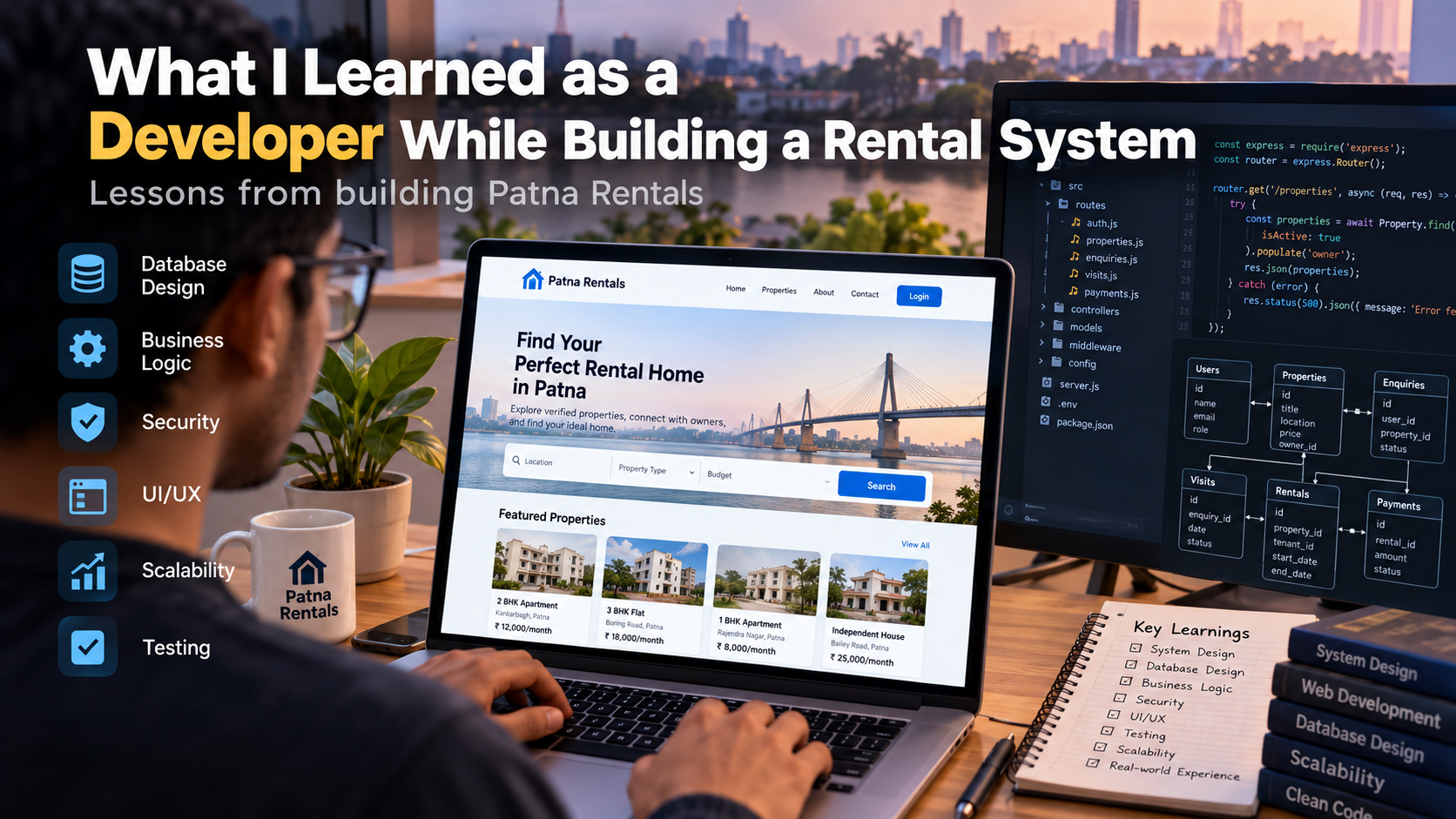
Building Patna Rentals was more than just another web development project for me. It gave me the opportunity to understand how a real-world rental platform works from both a technical and business perspective.
While working on the project, I learned how to convert a business idea into a structured digital product, design scalable architecture, manage complex data relationships, and build features around actual user needs.
Here are some of the most important things I learned as a developer.
1. Understanding the Real Business Problem
One of the first things I learned was that development should start with understanding the problem, not writing code.
A rental platform involves multiple users and workflows:
Property owners
Tenants
Property managers
Admins
Property listings
Enquiries
Property visits
Rental agreements
Payments
Complaints and support
Understanding these workflows helped me realize that a good developer needs to think beyond individual features and understand how the complete system operates.
2. Converting Requirements into Modules
A large application can quickly become difficult to manage if everything is developed together.
I learned to break the system into independent modules such as:
User Management
Property Management
Property Search
Tenant Management
Owner Management
Enquiry Management
Visit Scheduling
Rental Management
Payment Management
Notifications
Reviews and Feedback
Admin Dashboard
This modular approach makes development, testing, debugging, and future expansion much easier.
3. Database Design Is Extremely Important
One of the biggest technical lessons was understanding the importance of a well-designed database.
A rental platform contains many relationships.
For example:
User → Property → Enquiry → Visit → Tenant → Rental Agreement → Payment
Instead of storing everything in a single table, I learned how to separate entities and create meaningful relationships between them.
This helped me understand concepts such as:
Primary keys
Foreign keys
One-to-one relationships
One-to-many relationships
Many-to-many relationships
Data normalization
Transaction records
Audit logs
A good database structure can make the entire application easier to build and maintain.
4. Designing APIs Around Business Logic
Another important lesson was that APIs should not simply perform CRUD operations.
Real applications require business logic.
For example, when a tenant requests a property visit, the system may need to:
Check whether the property is available.
Check the owner's availability.
Create a visit request.
Update the enquiry status.
Notify the owner.
Notify the tenant.
Maintain an activity record.
This taught me that backend development is largely about converting business rules into reliable application logic.
5. Authentication and Role-Based Access
Different users should not have access to the same information.
For example:
Tenant
→ Search properties
→ Submit enquiries
→ Schedule visits
→ Manage rental information
Admin
→ Manage users
→ Verify properties
→ Monitor transactions
→ Handle complaints
→ View analytics
→ Add properties
→ Manage enquiries
→ Manage tenants
This helped me understand the importance of authentication, authorization, permissions, and role-based access control (RBAC).
6. Handling Real-World Edge Cases
A major difference between a simple project and a real application is the number of edge cases.
For example:
What if a property is already rented?
What if two tenants request the same property?
What if a scheduled visit is cancelled?
What if a payment fails?
What if an owner removes a property?
What happens when a rental agreement expires?
What if a user submits incomplete information?
Thinking about these situations helped me improve my ability to design systems that don't only work in the happy path.
7. Building a Better User Experience
I also learned that good development isn't only about functionality.
A feature can technically work but still provide a poor user experience.
For a rental platform, users should be able to:
Search → Filter → View Property → Check Details → Enquire → Schedule Visit → Rent
with as little friction as possible.
This made me pay more attention to:
Simple navigation
Clear forms
Responsive design
Loading states
Empty states
Error messages
Confirmation messages
Mobile usability
The goal is not just to build a working application but to build one that people can actually use comfortably.
8. Thinking About Security
Working on a platform that handles user information and rental transactions also made me understand the importance of security.
I learned to consider:
Secure authentication
Password protection
Input validation
API authorization
SQL injection prevention
File upload security
Access control
Secure payment handling
Sensitive data protection
Activity logging
Security should not be treated as a final step. It needs to be considered while designing the system.
9. Managing Property and Media Data
Rental platforms depend heavily on property images and other documents.
This introduced another important development challenge: file and media management.
I learned that applications need to consider:
Image upload
File validation
Storage
Image optimization
Multiple property images
Document management
Access permissions
File deletion and replacement
This is something that may look simple initially but becomes important as the number of properties grows.
10. Understanding Admin Systems
Before this project, it was easy to think of the admin panel as just another dashboard.
While designing the rental system, I understood that the admin panel is actually the control center of the platform.
An admin may need to manage:
Users
Properties
Verification
Enquiries
Visits
Rentals
Payments
Complaints
Reports
Notifications
System settings
This taught me how important operational tools are for real-world software.
11. Thinking About Scalability
Another major lesson was learning to think beyond the current number of users.
A system designed for 100 users may work completely differently when it reaches:
1,000 → 10,000 → 100,000 users
This means considering:
Database indexing
API performance
Pagination
Caching
Image optimization
Background jobs
Efficient queries
Modular architecture
Monitoring and logging
Even if these systems aren't required immediately, designing with future growth in mind prevents major architectural problems later.
12. Testing Is Part of Development
I also learned that writing code is only one part of software development.
Every important workflow needs to be tested.
For example:
Property Listing
→ Create
→ Update
→ Publish
→ Search
→ Enquire
→ Schedule Visit
→ Rent
Each stage can introduce bugs.
Testing helped me understand the importance of:
Functional testing
API testing
Validation testing
Role-based testing
Edge-case testing
Security testing
Responsive testing
13. Documentation Saves Time
Another important lesson was the value of documentation.
When a project becomes large, it becomes difficult to remember:
Why a feature was implemented
How modules interact
What each API does
Which tables are related
What business rules exist
How different user roles work
Proper documentation makes it easier for developers to understand, maintain, and extend the system.
14. Development Is Also About Making Decisions
Perhaps the biggest lesson from this project was that development isn't just about knowing programming languages.
A developer constantly has to make decisions:
Which architecture should we use?
How should the database be structured?
Which functionality should be implemented first?
What happens if something fails?
How should users interact with the feature?
How can this system scale later?
These decisions require a combination of technical knowledge, problem-solving, product thinking, and business understanding.
What This Project Taught Me Overall
Building Patna Rentals helped me move from thinking like someone who simply writes code to thinking more like a software engineer.
I learned to look at an application as a complete ecosystem:
Business Requirement → System Design → Database → Backend → API → Frontend → Security → Testing → Deployment → Maintenance
The biggest takeaway for me is simple:
A good developer doesn't just build features. A good developer understands the problem, designs the system, anticipates failures, and builds a solution that can grow.
Patna Rentals gave me practical experience with this complete development mindset and helped me understand what it actually takes to build a real-world software product.